

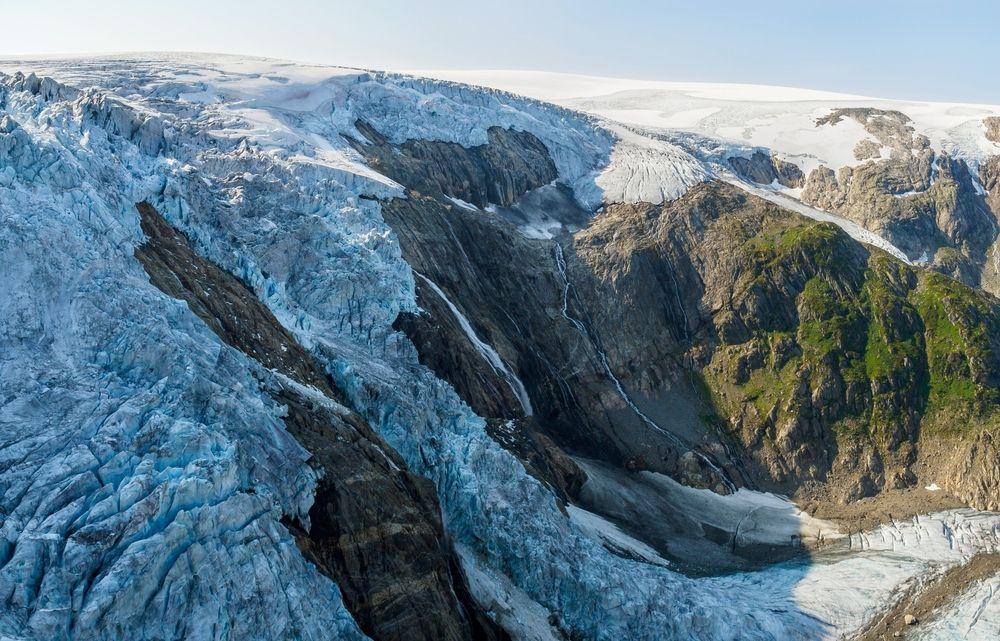
Folgefonna is one of mainland Norway’s largest glaciers, a dramatic ice cap stretching across the Folgefonna peninsula in Vestland county. It’s actually three interconnected plateau glaciers — Nordre (north), Midtre (central) and Søndre (south) — together covering roughly 200 km² of ice and snow. The southern part, Søndre Folgefonna, is the third-largest single glacier on the Norwegian mainland. In 2005, Norway created Folgefonna National Park to protect not only the ice but also the dramatic fjords, valleys, rivers, and mountain landscapes that surround it.
Geological Story: From Ancient Rocks to Ice Sculpting
The land beneath and around Folgefonna is ancient — with rocks that are hundreds of millions to over a billion years old, shaped by continental collisions and mountain-building events long before humans appeared. During the last Ice Ages, enormous ice sheets covered most of Scandinavia. As they melted about 10 000 years ago, they carved deep valleys and fjords — including the famous Hardangerfjord that hugs the glacier’s western edge — and left behind the iconic U-shaped landscapes that define much of Western Norway.
Today’s Folgefonna is a remnant of those great ice sheets, continuing to shape the land beneath it and feed glacial rivers and waterfalls. Research shows the ice has been receding in recent decades as climate warms, exposing more rock, valleys, and moraine fields.
Folgefonna & Cultural History
While Folgefonna itself doesn’t figure prominently in written Viking sagas, the region around it — Hardangerfjord and Vestland — was home to Norse culture and early Viking communities beginning around 800 CE. Western Norway was an active part of the Viking world, with Norse farmers, craftsmen, seafarers, and explorers expanding outward across the North Atlantic. Hardangerfjord settlements such as Kinsarvik were occupied in early medieval times and strategically important because fjords acted as natural harbors and protected travel routes. Vikings and Iron Age communities sailed and farmed in these fjord landscapes, with waterways linking them to the wider Norse world. While the glacier itself wasn’t a place of settlement, the ice-shaped landforms — deep fjords, fertile valleys, and navigable waterways — were crucial to daily life and Viking Age travel. Fjords like Hardanger played roles in transport, fishing, trade, and defense — all part of Norse culture in this part of Norway.
Access Today: How to Visit Folgefonna
Folgefonna is relatively accessible for nature lovers with a bit of planning:
Entry Points
- Jondal — a common starting point on the western side of Hardangerfjord. From there, you can take the scenic Glacier Road up toward the glacier plateau.
- Odda / Buer — access the glacier’s outflows and valleys on the eastern side.
- Rosendal and the Folgefonn Centre — good starting point for learning about the park before exploring nature.
- Public transport options exist in summer between Bergen, Norheimsund, and Jondal, and seasonal bus/boat combinations help get you closer to the glacier hiking start points.
- The Glacier Road itself climbs high into the mountains, offering dramatic views and access to guided hikes — often starting near the former ski center at about 1200 m elevation.
Guided Glacier Access vs. Going Alone
Important safety note:
Do not walk on the glacier without a certified guide or proper mountaineering experience. Glaciers are dynamic and dangerous environments:
Hidden crevasses can be covered by thin snow bridges.
Ice movement can be unpredictable, and large ice or rock can fall without warning.
Weather around ice fields changes rapidly — clear skies can turn into white-out conditions fast.
Guided hikes are offered in summer (typically June–October) by trained teams such as the Folgefonni Breførarlag, who provide safety gear, crampons, and expertise while explaining glacier formation, climate impacts, and local natural history.
There are also multi-day hiking routes (e.g., over the glacier between valleys) traditionally travelled — now best done with guides and proper planning.
Present Day & Future
Folgefonna remains a powerful symbol of Norway’s glacial heritage — a landscape shaped by ice over millennia, now facing climate changes that are visibly retreating the ice. In the national park, scientists study the glacier’s response to warming, and visitors can witness landscapes evolving in real time.
For nature lovers, history buffs, or anyone curious about how ice and people have shaped Western Norway, Folgefonna is a spectacular destination — just make sure you respect the ice and prepare responsibly.